January 2023

Skipping Stones


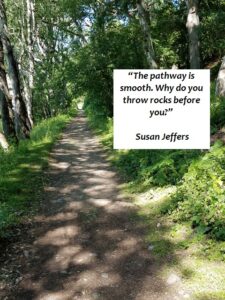
Are you a rock thrower? When you have a goal in mind, do you set off with purpose, moving ever forward, keeping up your momentum, and sticking resolutely to your goal? Or, do you focus on the reasons why you shouldn’t start? Do you find yourself creating obstacles to your success? Instead of just starting out, do you start to question whether you really need to achieve your goal?

I hate to admit it but I’ve tossed more than a few rocks into my smooth pathway.

Most of us have an Achilles heel of our own devising that keeps us from taking that first step towards achieving our goals. For us, then, the journey must be one of discovery and self-realization.

And the first step on this smooth pathway is paradoxically simple: You must start by exploring what it is that keeps you from getting started. Is it the fear of failure or, perhaps, the fear of success?

Visualize yourself getting started and then get in touch with what you’re feeling and thinking concerning this picture in your mind. Keep asking yourself, “What is underlying this?” Keep peeling the onion to reveal what lies beneath. Then try to discover what resources, emotions, or experiences you can draw upon to help you overcome the rocks you’ve thrown before you in your path. Most importantly, find out what it is that will keep you going – and make that happen!

Interested in doing a deep dive into smoothing the pathway before you? Check out my book, “I’ve Been Down Here Before But This Time I Know The Way Out.” You’ll hear from people who started out with one set of ideas, perceptions, thoughts, beliefs, and experiences, recognized the rocks they were throwing before them, and then ended up at a “not in a million years” place that was far different from anywhere they had been before. Most importantly, they’ll tell you how they did it so that you can do it too!

https://tinyurl.com/mvkk5j46

Skipping Stones Read More »

Be Willing To Be Willing

For most of us, giving ourselves permission is challenging. For many reasons, we can’t or won’t allow ourselves to put ourselves first. Instead, we simply put one foot in front of the other and gut it out.

Part generational, part genetic, part upbringing, there are many reasons why we never consider what we might really want or what might be in our best and highest interest. We simply do what we think, or believe, we have to do. We jump into the hole, we see the steep walls, and then we don’t even acknowledge that there might be a way out, let alone cry out for help.

But giving ourselves permission to willingly consider alternatives is the key to reinvention.

Consider this quote from Richard Bach: “No matter how qualified or deserving we are, we will never reach a better life until we can imagine it for ourselves and allow ourselves to have it.”

Willingness is a necessary precursor to taking action: you have to be willing to do something – or, at the very least, willing to try to do something – in order to keep moving forward.

I believe that when we give ourselves permission to rethink, to consider other possibilities, we crack open a door to our Higher Self – and our Higher Self, recognizing that the door has been cracked open, wedges a crowbar in to make sure that we consider a different way ahead.

In order to crack open that door to your Higher Self, you need to spend some time figuring out what it means to give yourself permission in terms of your own personal transformation and reinvention.

Once you can delve deeply into the concept of permission, you will be able to recognize the impact it can have, not only on your reinvention journey but on your entire life.

Want to learn more about giving yourself permission and the reinvention journey? Check out my book, “I’ve Been Down Here Before But This Time I Know The Way Out,” available on Amazon!

https://www.amazon.com/Been-Down-Here-Before-This/dp/1514123150

Be Willing To Be Willing Read More »

A Wolf In Sheep’s Clothing

“When you live your story, you don’t have to pretend you’re someone you’re not. You can just be yourself.” Blake Mycoskie

Personally, I love pretending to be someone I’m not. My two favorite things are Halloween and historical reenactment. I have a basement full of costumes, and I like nothing more than dressing up like someone else.

Donning a costume allows me to unleash my inner wannabes. Wannabe a knight in shining armor? Wrap yourself in aluminum foil and strap on a kitchen knife (I’m all about improvising when I need to). Wannabe a rock star? Try some fake tattoos (or the real thing, if you’re so inclined; I happen to be covered with body art), grab a plastic guitar, and use a garden spade as your microphone (like I said, I’m good at improvising). Or, make it really easy, and just head to the nearest karaoke bar.

At one time or another, all of us have had to pretend to be someone else. “Fake it ‘til you make it” is a well-known phrase in recovery forums, and has become a mainstream sentiment as well. Nervous about an upcoming interview? Pretend to be the smartest person on the planet. Afraid of public speaking? Pretend you’re just talking to a friend (that whole, “picture everyone naked” approach never worked for me anyway).

However, being yourself is just a whole lot easier than trying to be someone you’re not. It takes an incredible amount of psychic and spiritual energy to be constantly making yourself up as you go.

For example, as long as you have to work in order to have what you need or want your life to include, you’ll be happier—or at least more willing to show up and do the work—if the work you do aligns with your Authentic Self and what is most important to you. If you describe yourself as Introverted, you might be happier teleworking than working in an office environment where everyone is chummy, and there is an expectation of doing things together socially. As another example, if you define yourself as Spontaneous, you might find that working at a 9-to-5 job where you have to sign in and out is too restrictive.

Oscar Wilde said this, “Be yourself. Everyone else is already taken.”

Are you living your own glorious, inspiring, significant life story? Or, are you a wolf in sheep’s clothing, longing to howl at the moon, but only able to bleat weakly with the other sheep?

Think about it!

A Wolf In Sheep’s Clothing Read More »

3×5 Full of Gratitude

I don’t know about you, but among the many things I’m grateful for are tools. Duct tape, an electric screwdriver, and a set of diamond drill bits are among my BFFs. And, don’t get me started on how much I love my Sawzall—no overgrown tree on my property is safe!

So whenever I start something new—a new job, a new book, a new DIY project—I look for the appropriate tools that will help me succeed.

We all know the saying, “Use the right tool for the right job.” Thomas Carlyle even went so far as to declare, “Man is a tool-using animal. Without tools, he is nothing. With tools, he is all.”

Look out Home Depot, here I come!

Nearly 35 years ago when I embarked on my sobriety journey, I approached this “project” in the same way: I looked for tools I could use that would help me get sober and, more importantly, stay sober. Because, after all, what’s the point of building a barn only to have it fall down because I used the wrong tools?

“The greatest enemies of us alcoholics are resentment, jealousy, envy, frustration, and fear. When [these feelings] come, stop and count your blessings.” The Big Book of Alcoholics Anonymous

When I first got sober, these “greatest enemies” were the only feelings I recognized. So I knew right away that I would need a really powerful tool in my spiritual toolkit if I was going to have any hope at getting and staying sober. And that tool was the Gratitude List.

But exactly why is a Gratitude List so important?

Because when you are in the midst of emotionally paralyzing, negative feelings, you literally can’t think clearly. On the other hand, when you are in the midst of gratitude, you literally can’t conceive of negative emotions, let alone feel them. Or, as M.J. Ryan succinctly put it, “Whenever we are appreciative, we are filled with a sense of well-being and swept up by the feeling of joy.”

Knowing that negative feelings can cloud clear thinking, my AA sponsor encouraged (okay, actually demanded) that I write down what I was most grateful for on a 3×5 card and keep the card with me at all times. That way, whenever the negative thoughts and emotions threatened my serenity or my sobriety, I could pull out that little card, read over everything I had written down, and remind myself of the many blessings I did have as a result of just not taking that one drink again.

And so I dutifully wrote down the things I was grateful for, and I kept my 3×5 index card always at the ready—and believe me, I pulled that little lifesaving tool out of my spiritual toolkit dozens of times in the first year of my sobriety, and countless times since then.

Gratitude shifts your focus from what your life lacks to the abundance that is already present. In addition, research has shown that giving thanks makes people happier and more resilient, strengthens relationships, improves health, and reduces stress.

Wow—all that from one little 3×5 card? What’s not to be grateful for?

William A. Ward said, “God gave you a gift of 86,400 seconds today. Have you used one to say ‘thank you?’”

Do you fleetingly think about what you are thankful for? Or does your gratitude extend beyond a single day? And how might practicing gratitude and giving thanks for everything transform your “common days into thanksgivings” each and every day?

3×5 Full of Gratitude Read More »

Scroll to Top

Join The List

Sign up to receive personal transformation tips and tricks plus freebies, offers,and more!